
What Signal-Based Sourcing Actually Means

Last fortnight we talked about the twin failure of keyword search, how it misses good candidates and surfaces bad ones at the same time. If you haven't read that, start there. This piece builds on it.
The fix isn't a better keyword list. It's a different methodology entirely. Signal-based sourcing.
The core idea
Keyword search asks: who describes themselves using this term?
Signal search asks: who has done the work that practitioners in this domain do?
Those are different questions. They produce different results.
The reason keyword search fails is that the vocabulary of job seekers, especially optimised, LinkedIn-native job seekers doesn't map cleanly onto the vocabulary of people actually doing the work. Practitioners use domain-specific language. Frameworks, standards, tools, methodologies. They write about outcomes, migrations, builds. They don't write "strong communication skills." They write "led cross-functional alignment between 14 engineering pods during a platform re-architecture."
That's a signal. Not a keyword.
Two types of signals
Not all signals are the same. The ones that matter fall into two categories, and mixing them is a common mistake.
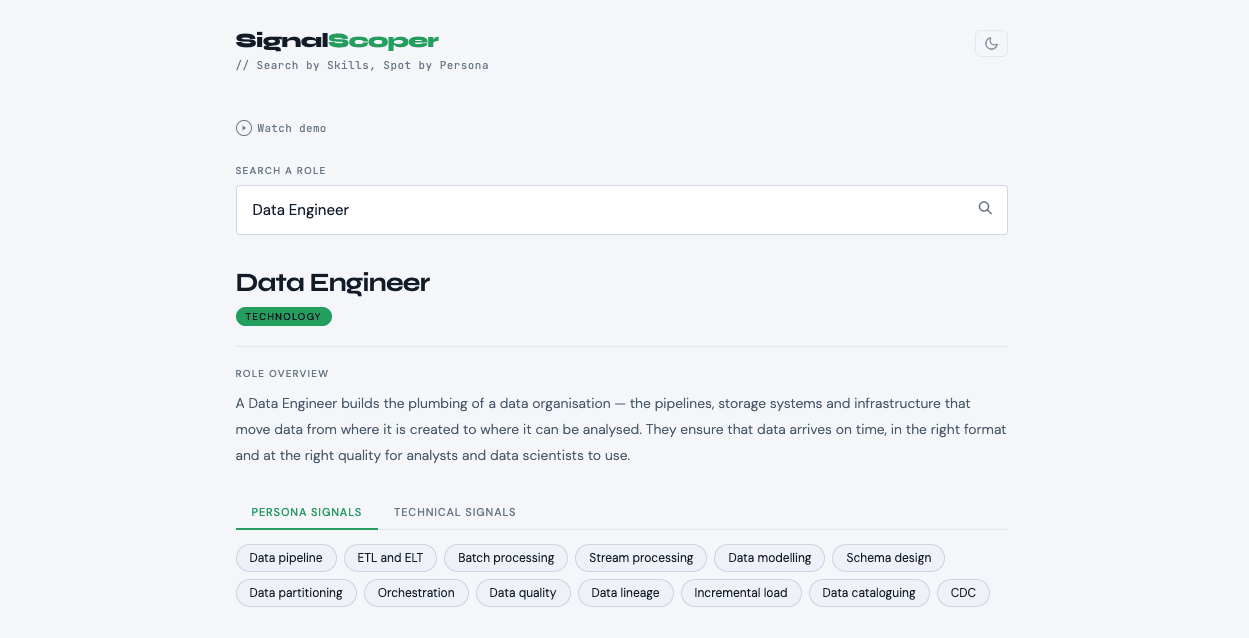
Persona signals are the language people use to describe how they work. Not what they work on — how. "Built from scratch." "Owned end-to-end." "Led migration." "Rebuilt the process." These show up in summaries, headlines, project descriptions. They tell you about agency, ownership, scope.
Technical signals are the specific vocabulary of a domain. Tools. Frameworks. Standards. Regulation names. Not "data engineering" — "Apache Iceberg", "dbt incremental models", "Spark structured streaming." Not "compliance" — "SEBI LODR", "RBI master directions", "concurrent audit framework."
These two layers of signals work differently. Persona signals tell you about how someone operates. Technical signals tell you about where they've operated. Together, they let you find people who have both the functional fluency and the domain depth you need.
In a Boolean string, keep them separate. One tab for persona. One tab for technical. Run them independently. Use them to cross-reference, not to combine into one noisy query.
Where signals come from
Here's the key step most recruiters skip: signals should come from profiles of great performers, not from job descriptions.
JDs are written by hiring managers. They describe what the company wants. They use the company's vocabulary, not the candidate community's vocabulary. And they're optimised for internal alignment, not for finding people.
Real signals come from reverse-engineering. Take the best people you've placed or interviewed in a given function. Read their profiles, their CVs, their GitHub repos, their Stack Overflow answers. What terms show up consistently? What frameworks do they name? What do they say about their work that generic candidates don't?
That's your signal library. It's built from evidence, not assumption.
In the Indian market specifically, this matters even more. Domain-specific vocabulary here has a local character. Credit risk professionals write about "CIBIL bureau integration", "NPA classification", "RBI IRACP norms" — not just generic credit risk terminology. Healthcare recruiters who know to look for "NABH accreditation", "pharmacy dispensing workflow", "MRD coding" will find a completely different (and better) pool than those searching "healthcare management."
The signals are India-first by nature. Your library should be too.
What this looks like in practice
Let's walk through a real example. You're sourcing for a DevOps Engineer. Mid-senior. The team uses Kubernetes heavily and is in the middle of a cloud migration.
Generic keyword search: "DevOps Engineer" + "Kubernetes" + "AWS"
That's a crowded pool. Every optimised profile has those terms.
Signal-based search — technical layer: "Helm chart", "ArgoCD", "Istio service mesh", "Kubernetes cluster autoscaler", "Terraform modules", "multi-region failover"
Signal-based search — persona layer: "led migration", "built from scratch", "owned infra", "reduced deployment time", "zero-downtime"
Now your search is reading for practitioners. The people who surface aren't necessarily titled "DevOps Engineer" — some are "Platform Engineers", some are "SREs", some are "Cloud Architects." But they've done the work. Their profiles show it in the specific vocabulary they use.
That's the candidate pool keyword search never reaches.
The upfront investment
Signal-based sourcing takes more work to set up than keyword search. You need to build the signal library. You need to separate persona signals from technical signals. You need to validate them against real profiles, not assumptions.
But it's a one-time investment per domain. Once you have a solid signal set for credit risk, or DevOps, or clinical data management, it compounds. Every search gets faster and cleaner. Every pool is more relevant. Every shortlist has a higher hit rate.
The alternative is rebuilding a broken keyword list every time you open a new role. Most recruiters are doing that. And wondering why their pipeline keeps disappointing them.
Closing
Signal-based sourcing isn't magic. It doesn't eliminate bad candidates or surface perfect ones automatically. What it does is ask a better question and consistently, a better question produces a better pool.
The hidden market isn't hidden because good candidates are hard to find. It's hidden because most search strings are asking the wrong question.
Change the question. The pool changes with it.
SignalScoper has signal libraries for 228 roles across Technology, BFSI, Healthcare, and Manufacturing — built from practitioner vocabulary, not JD language. Free. No login. signal.sourcer.club